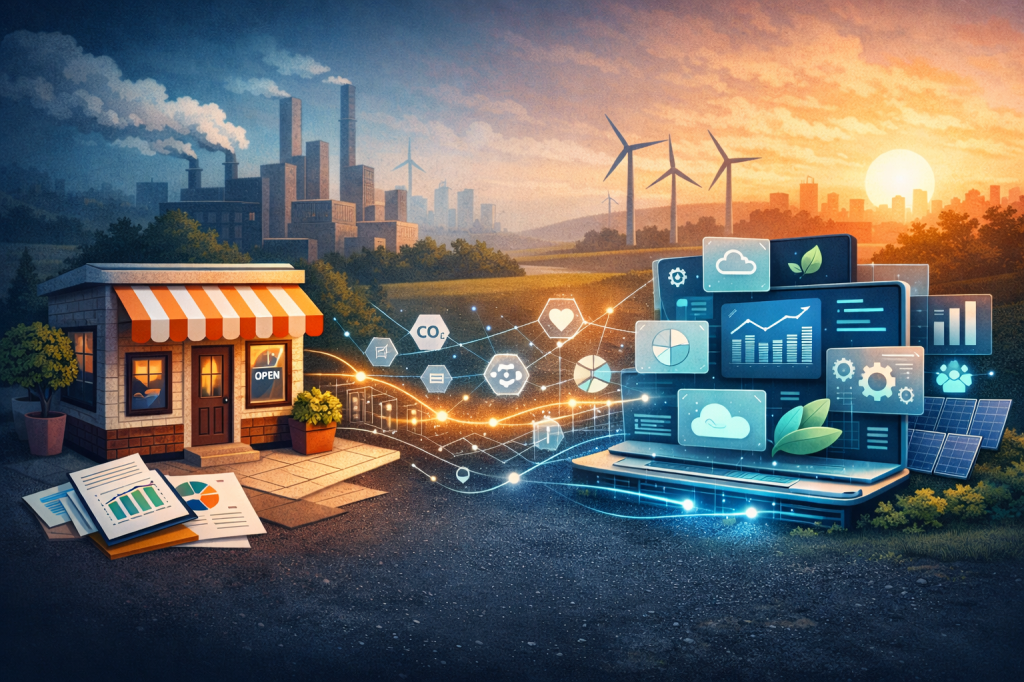
"The revised standards offer a rare opportunity to rethink sustainability reporting as a tool for value creation and risk management, not just compliance"
When we look to companies such as Shell, Unilever and Maersk, most of us can see the logic in asking them to report on ESG. These organisations have the budget, time and internal resources — not to mention access to armies of consultants — to keep pace with ever-changing regulation.
But what happens when that same reporting pressure is passed down to smaller companies without the internal infrastructure or tools to know how?
A recent article from the World Economic Forum (Article) highlights the importance of SMEs to both our economy and overall climate reporting. The problem is that climate reporting is targeted at SMEs, not designed for them. They are being asked for Scope 3 data they don’t fully understand, under tight timeframes, and without the internal expertise, time, or appetite to suddenly acquire a PhD in carbon accounting.
The market assumes that if we make climate reporting “simpler” for SMEs, the problem will be solved. But simplification isn’t the same as usability. (As anyone using Snapchat circa 2018 could tell you). Most tools are still designed around compliance logic, not around how an SME operates. They collect data, but they don’t help smaller businesses decide anything.
We continue to assume that making reporting simpler, smarter, and more scalable will fix the issue and while this direction is not wrong, its built around treating reporting as the end goal. What’s emerging doesn’t fully support that narrative.
What is coming to light is a shift away from climate reporting as a periodic compliance exercise and toward climate data as operational infrastructure. A recent article from BCG (article) highlights the need for companies to rethink how they approach Carbon Reporting, turning it into a tool for risk management, value and strategy rather than just compliance. A sentiment echoed by the Australian Institute of company directors. (Article.)
In practice, this means moving away from annual, retrospective reports compiled under pressure, and one-off data requests driven by regulation or large customers — and toward continuous, lightweight data capture embedded in day-to-day operations. Data that can be reused across customers, lenders, insurers, and regulators. In short, climate information that helps SMEs anticipate questions rather than react to them.
This shift matters because SMEs don’t engage with climate reporting as a moral or regulatory project. When climate data behaves like infrastructure, reporting becomes a by-product, not a burden. Consistency improves because data is maintained, not recreated. And that’s the real shift underway: the future of SME climate reporting won’t be better reports — it will be better systems embedded into the companies themselves.
 The Practical Climate
Leave a comment